
Presentation

The Ligurian
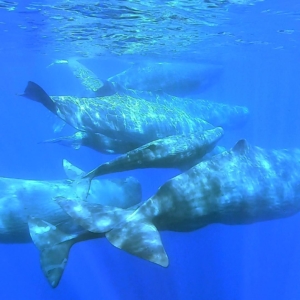
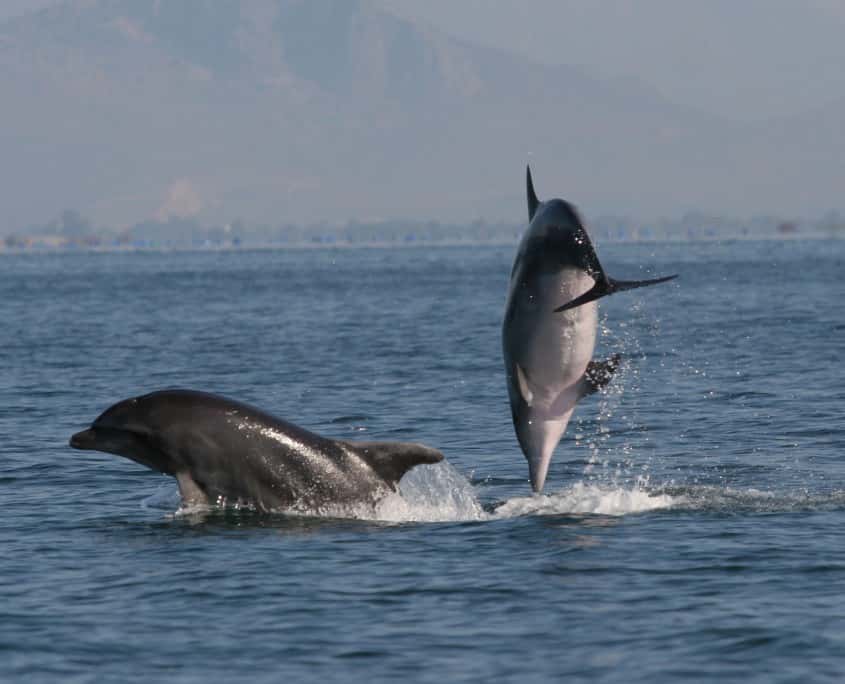
Sea counts one of the highest concentration of whales and dolphins
in
the Mediterranean and as many as eight cetacean species are living there.
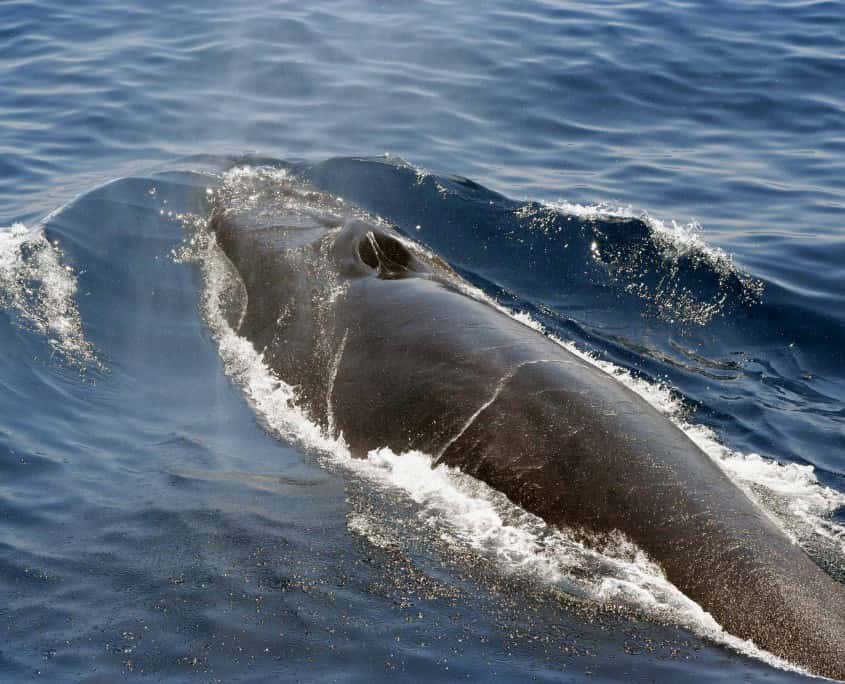
Cetaceans - particularly the impressive fin whale - have
become
a symbol for the protection of this marine environment.
Research
activities conducted by Tethys in the Ligurian Sea have led to the
identification
of a region critical to the habitat of several cetacean species. For
example, this basin represents one of the principal feeding grounds
for Mediterranean
fin whales, a population that in recent years has been found to be genetically
separate from its Atlantic counterpart (another good reason for preserving
it).
Unfortunately,
the Ligurian Sea is also affected by severe anthropogenic impact, including
pollution, heavy vessel traffic and intense fishing activities, providing
significant threats to the survival of cetaceans.
Since
1989, the awareness of these problems has led Tethys to put forward
a proposal
for the creation of a Marine Reserve in the Corso-Ligurian Basin, the "Project Pelagos".
After years of lobbying by Tethys and other environmental organisations,
the Governments of Italy, France and Monaco
got together
in 1993 and signed a joint Declaration for the creation of a Sanctuary for Cetaceans. The agreement was finally ratified in 2003,
and
although to this day the area has seen little change in terms of management,
the agreement represents an important step forward towards the final
goal
of ensuring protection to cetaceans living in the area.
In the meantime
several internationally renowned institutions have emphasised the
importance of the Sanctuary, including the World Conservation Union
(IUCN),
the Bonn Convention on migratory species, and the newly-born Agreement
on the Conservation of Cetaceans of the Mediterranean Sea, Black Sea
and
Contiguous Atlantic Areas (ACCOBAMS). The Sanctuary has also been added
to the list of Specially Protected Areas of Mediterranean Importance
(SPAMI),
created at the Barcelona Convention in 1999. This makes the Ligurian
Sea Cetacean Sanctuary the first and only high seas protected area
in the
world.
In order
to provide a scientific basis for management recommendations to the policy
makers, the final goal of Tethys' research in the Sanctuary is the basic
understanding of this extremely complex ecosystem. Intense research activities
conducted by Tethys in this region have also been raising remarkable public
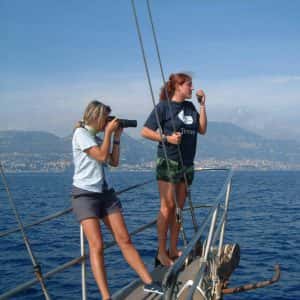
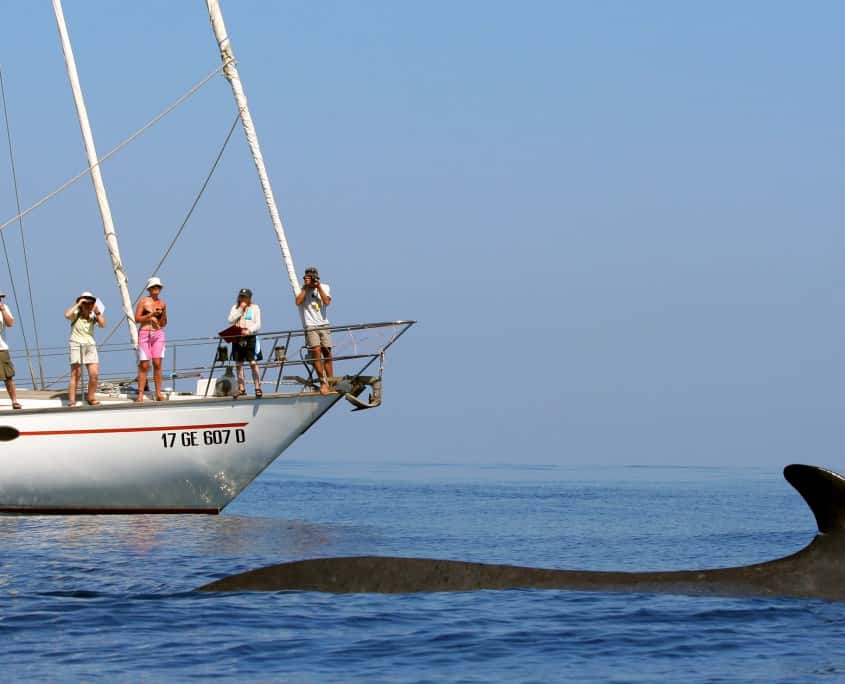
awareness. Since 1992, almost 2,000 volunteers have participated in the
cruises dedicated to Tethys' cetacean research. Living on board for many
days and co-operating to the different phases of the research creates
a bond between researchers and volunteers, transmitting to the latter
a committment for environmental conservation.
Research
carried out in the Cetacean Sanctuary by the Tethys Research Institute
includes the study of cetaceans in the two main habitats: continental
slope and offshore waters. Research focuses on the spatial distribution,
habitat preferences, ecology and behaviour by all cetacean species living
in the Sanctuary.
The research
described above is conducted by means of field techniques including individual
photo-identification, remote tracking, acoustics, distance sampling, behavioural
sampling, remote sampling of skin biopsies, mark-recapture analyses and
the use of time-depth recorders.
Study area
Our study area lies in the Pelagos Sanctuary and covers about 25,000
km2, including the waters between Genoa, the islands of Porquerolles and
Cape Corse on the island of Corsica.

CSR study area within the Pelagos Sanctuary
While most of the Mediterranean is considered an oligotrophic sea, the
western Ligurian Sea is characterized by high levels of primary productivity,
caused by the interplay of climatic, oceanographic and physiographic factors.
A dominant cyclonic (counterclockwise) current, flowing north along Corsica
and Tuscany and thence hugging the coast of Liguria and mainland France
in a westerly direction, creates a permanent frontal system which separates
coastal and offshore waters. Intense biological activity is generated
along this water mass boundary by the enhanced productivity and retention
associated with this frontal system.
I
Remotely sensed sea surface temperature (SST) during October 2006, in
agreement with the frontal system (©Nasa)
Such phenomena are intermittently and seasonally reinforced by vertical
mixing and coastal upwelling, generated by the prevailing north-westerly
wind ('mistral'), which pumps deep nutrients and other organic substances
contributed by rivers, most notably the Rhone, into the euphotic zone,
where they fertilize growing phytoplankton populations.
I
Remotely sensed chlorophyll a concentration in the Mediterranean Sea
during April 2003 colour -coded to highlight different productivity levels
(©Nasa)
Research
methods
From 1990 to 2007, over 178,700 Km were travelled during 2,192 days spent
at sea.
Visual and acoustic surveys were conducted on a daily basis. All the
navigation data (position, speed, course), environmental data (sea state,
weather, visibility, cloud coverage) and qualitative acoustic data (acoustic
pollution and cetacean vocalizations by listening on the towed hydrophone
array) were recorded. Human activities were also monitored (counting all
types of boats, ships and fishing gear in a radius of 3 nm from the ship),
and the presence of other marine animals (including sea turtles, tunas,
mobulas, rays, swordfish and seabirds) were reported. Geographic position,
movements, group size and composition of the cetaceans were also recorded
during long-lasting observation sessions.
The various nature of the questions investigated by this study requires
a multidisciplinary approach, thus entailing the use of a wide range of
techniques.
Photo-identification enables
researchers to recognise individual animals by taking pictures of their
morphological features like the profile of dorsal fins or scars on
their body. A photoID-based monitoring programme provides crucial information
on cetaceans' distribution, habitat use, population estimate, social
structure, seasonal presence, movements and association patterns.
Vocalisations
and acoustic data are used to detect and follow the animals
by means of a towed hydrophone array. The concurrent collection of
behavioural data is aimed at assessing the functional meaning of
the animals' sounds.
Behavioural
study and respiration patterns, collected according to a dedicated
protocol, enable to gain important information about different aspects
of the animal's biology and about their interactions with human activities.
Skin swabbing: skin cells from some dolphins species are collected
by "touching" them with a special sponge on top of a pole. By
the DNA, genetic variability of the population, individual gender, population
inbreeding, kinship patterns, and social structure can be assessed. From
some species, like striped dolphins, skin and blubber samples were remotely
collected. Blubber samples were used to determine concentrations of man-made
contaminants, like polychlorobiphenils (PCBs).
Remote
underwater tracking: velocity-time-depth recorders (v-TDRs),
are attached to cetaceans by means of a suction cup. This very sophisticated
technique allows to obtain diving profiles and to record maximum
depth reached, swimming speed couples with environmental data.
Passive tracking of fin whales along the water surface are recorded
by means of a laser range-finder, a GPS, and a dedicated software, with
the concurrent timing of respirations. This technique is used to assess
and quantify fin whales' reaction to anthropogenic disturbance.
Photogrammetry: measuring sperm whales' length at sea from boat
through photogrammetric echnique. It involves taking an identification
photograph of the fluke while simultaneously measuring the distance to
the animal through a laser range finder. The animals' length is then calculated
from the proportion of the fluke span to body length.
Faecal
sampling is occasionally performed at the water-surface with
the aim to investigate feeding habits of the species. The analysis
of fin whale faeces showed the almost exclusive presence of a small
planktonic crustacean considered as the main prey species for fin
whales in the Ligurian Sea while the analysis of sperm whale faeces
provided the first insight of the diet for sperm whales in the Mediterranean
Sea.
|